NRMAPolicy actdraft
The Natural Resource Modernization Act
The non-water sibling of the Remix — twenty-four frameworks that give Montana's fragmented land, mineral, wildlife, and climate statutes a single coordinated home.
- Jurisdiction
- Montana · MCA 75/76/77/82/87 + MEPA
- Frameworks
- NR-00 – NR-23
- Scale
- 24 frameworks · non-water resources
- Drafted
- 2026-05-21
- Anchored to
- MCA Titles 75/76/77/82/87 · MEPA · Federal hooks (CAA · RCRA · CERCLA · ESA)
If the Water Use Act Remix is Montana’s water reform, the Natural Resource Modernization Act is everything else — air, climate, energy siting, land, state trust lands, soil, mining, oil and gas, reclamation, wildlife, hunting and fishing, waste, contaminated sites, tribal and public lands, and wildfire. Its tagline says it plainly: “the act that organizes the rest.”
The problem it solves
Water law, after the Remix, finally has a coordinated home. Nothing else does. Every other resource lives under its own statutory title, its own agency, its own permit cadence, its own public-comment window — and they are under no legal obligation to talk to each other. As NR-00 puts it:
Montana’s state trust lands sit downwind of the smelter, downhill of the open pit, and upstream of the trout stream — but the agencies meet, when they meet, by personal invitation rather than by law.
NRMA makes them meet by law.
What it is
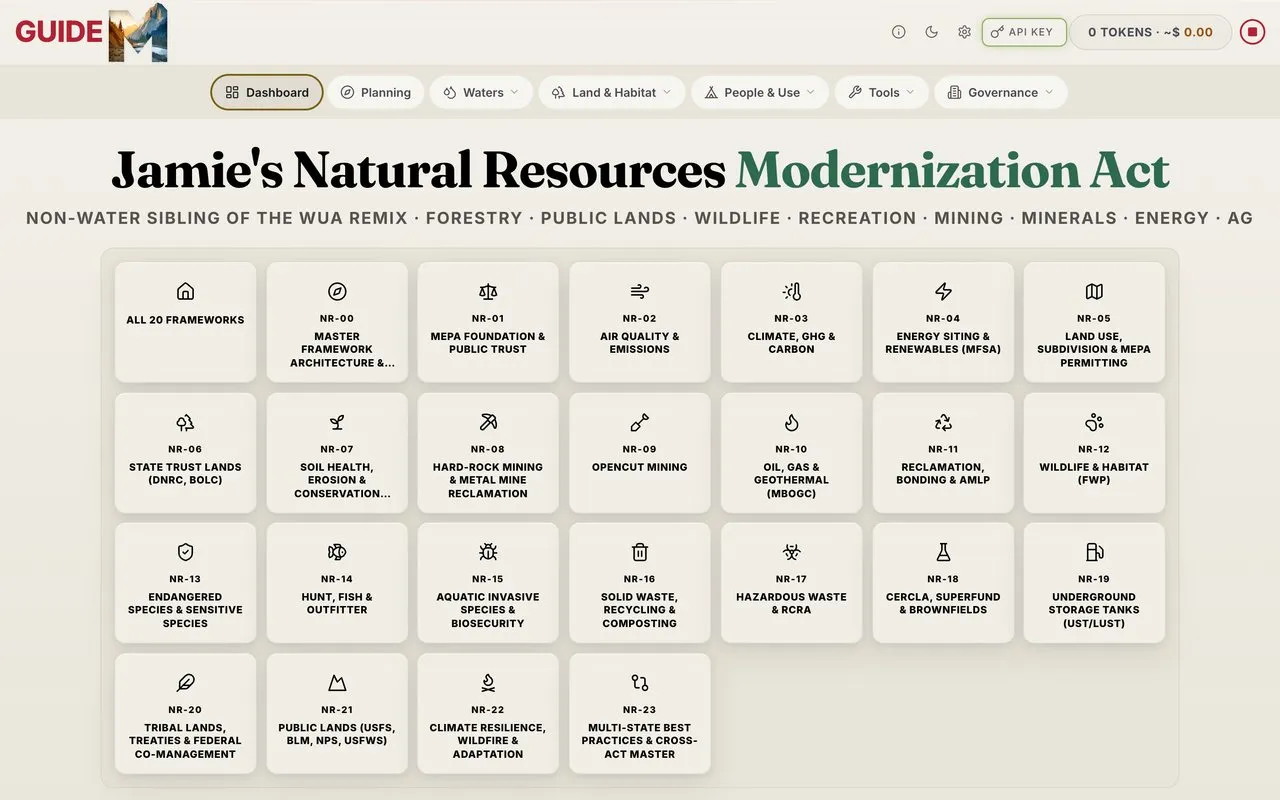
Twenty-four frameworks (NR-00 through NR-23), anchored to MCA Titles 75, 76, 77, 82, and 87 plus the Montana Environmental Policy Act and the federal statutes that shadow them (Clean Air, RCRA, CERCLA, ESA). The shape:
- NR-01 — MEPA Foundation & Public Trust. MEPA becomes the procedural backbone every permit shares, not a box checked in isolation.
- NR-04 / NR-08 / NR-10 — Energy siting, hard-rock & opencut mining, oil & gas. The extraction statutes, modernized and cross-linked to water’s adverse-effect standards so a dewatering permit can’t quietly drain a senior right.
- NR-12 – NR-15 — Wildlife, endangered species, hunt/fish/outfitter, invasive species. Habitat tied to the environmental flows next door in WUAR.
- NR-20 / NR-21 — Tribal lands & public lands. Co-management as a first-class citizen, not a footnote.
- NR-22 / NR-23 — Climate resilience & wildfire, and a cross-act master that compares twelve western states and stitches the whole system together.
Over it all sits a coordinating Implementation Council and a public docket — so coordination is a standing institution, not a favor.
Two acts, one system
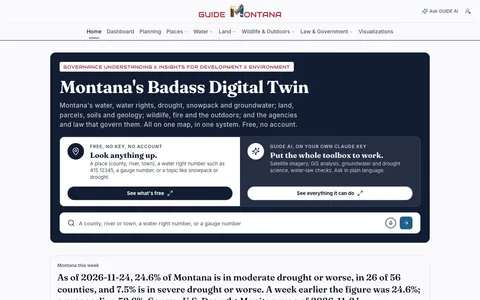
NRMA and WUAR are co-equal siblings, joined by a cross-act bridge of roughly ninety-five bidirectional links. WUAR brings the precise water standards and the live data infrastructure; NRMA brings the cross-agency coordination for everything else. Neither works alone — which is the point.
You can read the whole thing the way it’s meant to be read: as a living draft inside GUIDE Montana. Read the living draft below loads NRMA with all twenty-four frameworks laid out at once — the sibling view of the same platform that runs the Remix.