App2026Builder · Mapmaker
Quartermaster
The federal medical-device market, with the prices the VA publishes — which devices the VA, DOD, IHS and BOP buy, who holds the contract, when it ends, and whether you can sell direct. The verdict is free.
Launch Quartermaster (opens a new tab)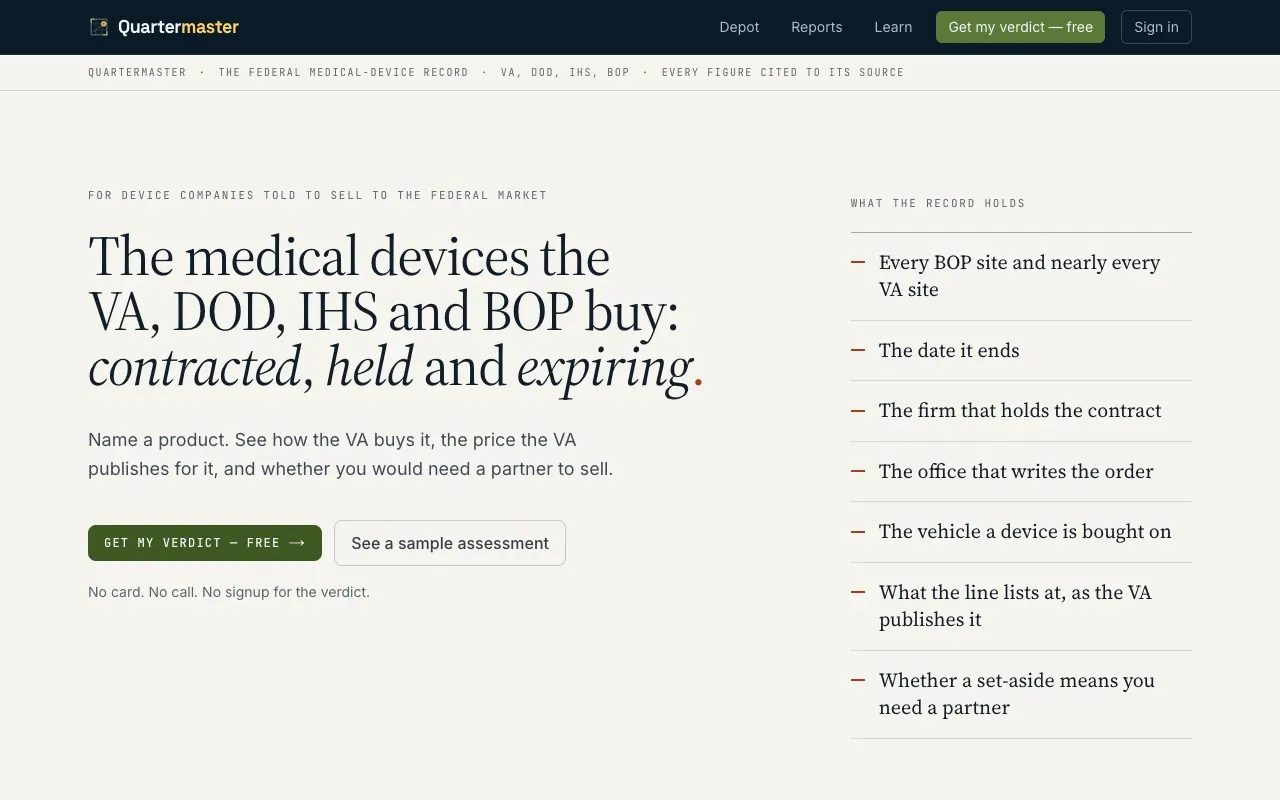
Quartermaster answers, with citations, how a device company gets into and grows inside the federal market — the VA, DOD/DHA, IHS and the Bureau of Prisons. Which facilities buy a category. On which contract vehicle, and when that contract expires. What the published price is. Which SDVOSB reseller can carry the line. And whether the manufacturer is even allowed to sell direct.
Name a product and it shows how the VA buys it, the price the VA publishes for it, and whether you would need a partner to sell. The verdict is free: no card, no call, no signup.
Why it stopped being everything
It began as broad commercial device intelligence — every facility, every cleared device, every Open Payments dollar, on one map you could ask in English. It pivoted on 2026-08-30, on a single uncomfortable fact: in the federal channel the product can answer a question completely. Everywhere else it can only ever answer “…of measurable Medicare fee-for-service” — a caveat that quietly invalidates most of what a rep would do with the number.
Narrowing was the honest move. A federal answer is a whole answer.
It is live at quartermasterdev — the public landing and the product behind it. Every figure carries its citation and the date it was read.
How it’s built
A Next.js 15 + TypeScript pnpm monorepo over PostgreSQL + PostGIS, with MapLibre GL for the spatial layer and the Anthropic Claude SDK behind the ask-in-English agent. Ingest workers pull and reconcile the public federal sources on a schedule, and the crosswalk that joins them is the moat.
The engineering discipline is the interesting part. Nothing in the README is a
number — each row points at where to read the live one instead, because a number
in a doc goes stale and nobody notices. Coverage isn’t “loaded” without a
termination proof. Schema parity is asserted against a database built from
schema.sql, and a test that can’t reach a database is red, never skipped.
A proof is a row in a table, never an exit code and never a deploy log’s last line.