The day before, I sent the Committee a letter about one bad idea — the plan to grandfather thousands of exempt-well subdivisions into statute without ever adding the wells up. That comment argued the law. This one argues the whole agenda.
Because when I read the materials posted for the July 21–22 meeting — the mitigation redline, the exempt-well bill draft, the grandfathering bill, the measurement bill, the water-reuse study, the drought outlook, the stream-gauge report — I noticed they all have the same shape. Every one is a plan to eventually do something: a bare bill with the hard parts deferred, a study that concludes by recommending more study, an annual PDF snapshot of a live problem. None of it is finished, and none of it runs.
So I brought the finished version with me.
The cover is not artwork
The image I put on the cover of my comment is the State of Montana rendered from its own records — every one of 150,773 Form 602 exempt-well certificates burning through the map at once, drawn live by an application called GUIDE Montana. Those wells draw an estimated 452,319 acre-feet a year — 2.26 million gallons a minute, about 7.7 times the flow of Yellowstone Falls — and not one of them was ever reviewed for adverse effect. Eight valleys zoomed in, each red point a single certificate, the Bitterroot floor near solid from wall to wall.
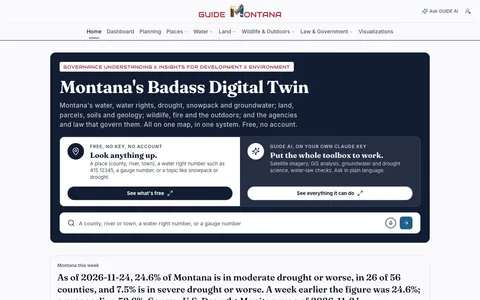
I built that application, and the two complete acts of natural-resource law inside it, alone and unpaid. It is free, public, and open in a browser right now. My comment sets it beside the Committee’s agenda, item by item, and asks one question: which of these is the comprehensive one?
The comment, as submitted
Public Comment for the Record — The Bar for “Comprehensive” To the Water Policy Interim Committee · 69th Montana Legislature · July 21–22, 2026.
Members of the Committee,
My name is Jamie Ellis. I am a citizen of Montana — not a lobbyist, not an agency, not a contractor. Before writing this, I read every document posted to your July 21–22 meeting-materials page: PD 2, PD 3, PD 4, and PD 5 with their staff memos, the HJ 74 water-reuse draft final report, the DNRC drought outlook, and the annual stream-gauge report. I respect the work those pages represent, and I respect this Committee for carrying it.
But I am going to be direct about what those pages are, because Montana’s water deserves directness. Nearly every document before you is a plan to eventually do something. I built the finished version — and I brought it with me. Here is your agenda, item by item, next to what already exists. Every row has the same shape: on the left, paper describing work to be done; on the right, the work done — statute, bill, rules, science, comparison, software — free and running.
PD 5 — Mitigation: a redline that asks for a plan, versus a system that produces one. PD 5 points in a defensible direction. It amends 85-2-102, -310, -360, -362, and -420; it cleans up the definition of mitigation; it requires a mitigation plan when a hydrogeologic report predicts net depletion. Those are reasonable sentences. But read what is not in its thirteen pages: no method for computing the net depletion that triggers the whole scheme, no administrative rules to implement it, no science, no survey of how Colorado, Idaho, Oregon, or Washington solved the same problem decades ago, and no mechanism by which an applicant actually finds mitigation water. PD 5 requires a mitigation plan the way a note on the refrigerator requires groceries. Its central verb — predict net depletion — is the one thing it never explains how to do. GUIDE Montana already does it, with the Glover-Balmer and Hunt analytical solutions, on real Montana basins: three proposed wells in the closed Gallatin basin, 4.137 AF/yr of estimated stream depletion, 91.9% per-well depletion at one year — the exact quantity PD 5’s scheme depends on and never computes. And when the tool says mitigation required, the machinery to satisfy it is not a concept in a working-group memo — it is a full market-intelligence hub, live: mitigation analysis, a water-rights marketplace, pricing, and the regulatory context governing every transfer.
PD 4 — Exempt wells: a bill draft, versus the analysis a court already ordered. PD 4 is one bill draft and a staff memo. The subject it regulates is the one two courts have now spoken to: Clark Fork Coalition v. Tubbs struck DNRC’s physical-connection rule, and in Upper Missouri Waterkeeper, Judge McMahon found DNRC “tortuously misreading its own rules and ignoring Supreme Court precedent” on combined appropriation — the duty to add up wells that share an aquifer. Whatever bill this Committee advances, the fix rises or falls on one question: can the State actually run the combined-appropriation, cumulative- impact analysis, at scale, well by well, basin by basin? GUIDE Montana already can. The exempt-well calculator encodes MCA 85-2-306 in full — the 35 GPM / 10 AF combined limit, the domestic/stock restriction, the CGWA exclusion, the 60-day Notice of Completion, and the HB 110 closed-basin net-depletion test — against real aquifer parameters, and every factual claim in the chapter is pinned to its source: the statute, the peer-reviewed science, and the case law, with a verification badge on the page.
PD 2 — Grandfathering: oppose as written; fix the harm, not the record of it. I oppose PD 2 as drafted, and I start with who I do not blame: the homeowners. They bought lots, received a DEQ subdivision approval and a DNRC letter saying their water was covered, and built their lives on it. Their whiplash is real, it is not their fault, and the State owes them a remedy. But this draft delivers that remedy by making Montana’s senior water-right holders — mostly farmers and ranchers — and its most stressed basins pay for a mistake they did not make. A real groundwater permit forces the applicant to prove no prior appropriator is adversely affected (85-2-311); in a closed basin it adds a hydrogeologic report and mitigation (85-2-360 through -362). The exempt-well path skips all of it. Statewide there are now roughly 150,773 Form 602 certificates drawing an estimated 452,319 acre-feet a year — none of it reviewed for adverse effect. Before you decide, look at the ground: the Bitterroot wall-to-wall on Basin 76H, the closed and blue-ribbon Gallatin, the Helena Valley on one connected aquifer, Kalispell draining to Flathead Lake. PD 2 would freeze thousands of those appropriations into statute without a single one ever clearing the tests that protect the person who was there first. The honest remedy already exists, and this Committee has it in hand: take care of homeowners case by case, with the hydrogeologic review and mitigation the law requires wherever a basin cannot absorb the draw. That is not administrative fantasy — the combined-appropriation screen, the depletion computation, and the mitigation marketplace are exactly the machinery that makes case-by-case review cheap, fast, and fair. Grandfathering is what you do when the analysis is too expensive to run. It no longer is.
PD 3 — Measurement: a bill and an annual PDF, versus a live statewide instrument. PD 3 proposes measuring and reporting; the annual stream-gauge report describes the network once a year. Both describe, on paper, what GUIDE Montana already operates as software: a live hydrology platform reading 500+ stream gauges (USGS + DNRC stage) and 30,000+ GWIC wells in one unified Gage View, with surface-groundwater connectivity, statewide snowpack, drought, and reservoir indicators — and an AI layer on top. This morning it auto-classified 231 gauges into flow condition — 81 in Drought, 55 Low, 31 Optimal, 22 High, 17 Flood — with per-gauge readings and anomaly detection. The annual report counts the instruments; this reads them.
HJ 74 — Water reuse: a study’s conclusion, versus a framework’s starting point. The HJ 74 draft final report is the end of an interim’s study of water reuse. It is competent work. But reuse is already drafted into statute with implementing rules in GUIDE Montana, and the report’s recommendations already exist as working tools: a project-feasibility screener, a beneficial-use class lookup under DEQ-2, and a mixing-zone calculator built on ARM 17.30.507. Your study’s endpoint is this framework’s page one.
The drought outlook: an annual snapshot, versus a living statutory engine. DNRC’s Drought & Water Supply Outlook is a PDF published on a calendar. Drought does not operate on a calendar. GUIDE Montana treats it as a continuous computation with legal consequences attached — a five-stage drought response system mapping live indices (SPI, SPEI, EDDI, SWSI, reservoir storage) to quantified triggers and mandatory agency responses, so the scramble happens in statute before the dry year instead of in meetings during it.
How one understaffed department does all of this: it doesn’t have to. Every analysis above runs on the same platform, and the platform’s answer to the capacity question is automation. The permit wizard carries Form 600 / 606 and the exempt-well Notice across 89 DNRC forms, with GIS auto-fill, AI review that flags missing fields before submission, and PDF/CSV export of the real forms — steps four and five of that intake are the adverse-effect analysis DNRC is sued over, built right into the door. Behind it sit two complete acts, readable end to end, every chapter exportable.
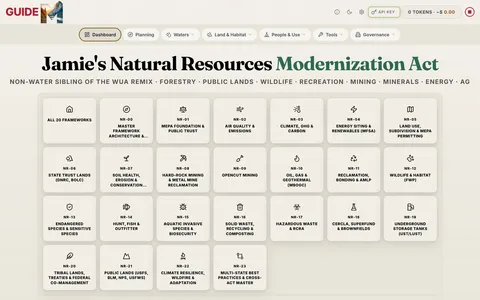
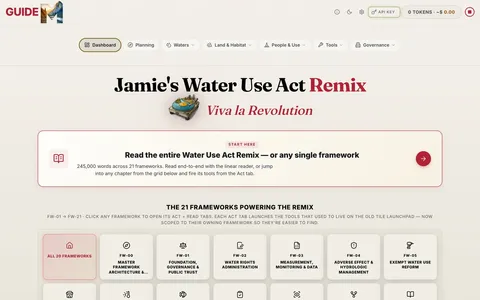
Nine states, cited statutes, and a second act — under every claim. Everything above sits on one editorial standard, applied forty-six times: every factual claim cited to the Montana Code, to peer-reviewed science, or to case law, with a verification badge on every chapter; a drafted bill and implementing ARM rules attached; and a comparative analysis of how nine western states — CO, ID, OR, WA, WY, TX, CA, NV, AZ — actually administer the same problem, statute to statute. The Water Use Act Remix is 22 frameworks and 245,000 words; its sibling, the Natural Resource Modernization Act, carries 24 more — air, climate, energy, land, mining, wildlife, endangered species, waste, tribal, and public lands — wired to the water act through 95 cross-act links, because water law and land law govern the same acre. Forty-six frameworks, roughly 639,000 words, every claim cited.
This is the bar now. The Comprehensive Water Review ran fifteen months with a paid staff, a stakeholder working group, and two agencies of record. Its own outline lists its exempt-well bill as “discussion of concepts,” its funding packages as “forthcoming,” and its answer to the hardest technical question in mitigation as a committee to be convened later. It produced five bills. In the same era, one unpaid citizen produced two complete acts — forty-six frameworks, each with statute, bill, rules, cited science, and a multi-state comparison — plus the working platform that automates the analyses the agencies say they lack capacity to perform. I do not raise this to diminish anyone. I raise it because “comprehensive” is a word that should mean something: nothing left to figure out later. Montana now has a live example of what that looks like. That is the bar, and it should never again be lower.
And let me be equally clear about what I am not saying. I am not saying these frameworks are perfect, or that they should not be reworked, redlined, and argued over — by this Committee, the tribes, the agencies, agriculture, conservation, and industry together. Collaboration is not a concession; I am insisting on it. What I am saying is that the starting point has changed. The work is done, and it runs. Montana does not have to begin from a blank page, a concept memo, or a technical advisory group. It can begin from a finished draft and a working machine.
The ask — three things. First, before you act on PD 4 or PD 5, open FW-05 and FW-06, run the tools, and measure the drafts before you against them. Second, do not advance PD 2’s blanket grandfather — fix the homeowners’ harm case by case with the review and mitigation the law requires, which the machinery above makes cheap and fast. Third, invite me to demonstrate GUIDE Montana live for this Committee. I will bring the whole system, and I will welcome the fight over every detail. This work is for Montana. Please use it.
Respectfully submitted for the record,
Jamie Ellis · Citizen of Montana GUIDE Montana · The Water Use Act Remix · The Natural Resource Modernization Act · guidemontana.up.railway.app